
The Post That Was Supposed to Ship Last Week
This article was scheduled to publish a week ago.
The draft was done. Cover image queued. Meta tags clean. Then Hermes shipped.
Hermes is a new agent orchestrator product from Nous Research. Multi-model, open source, multi-channel. The release landed in my feed exactly the week I was about to publish a post calling OpenClaw, the elephant in the room.
Two options. Publish as-is and pretend the new entrant didn't change anything. Or hold the post, stand up Hermes, run it through the same operator lens I had used on OpenClaw, and write something that reflects where the category actually is.
I held the post.
The delay turned into the argument. A week earlier, this was a single-product story. Today it's a market story.
A Quick Word on OpenClaw
For anyone outside the AI builder circle, OpenClaw needs a short introduction.
It started as a weekend hack by Peter Steinberger, the PSPDFKit founder, in November 2025. After a trademark complaint from Anthropic and a brief detour through the name Moltbot, it became OpenClaw in late January 2026, and detonated. By early March it had crossed 247,000 GitHub stars. No launch event, no Product Hunt campaign, pure word-of-mouth inside the builder community.
On March 5, 2026, at the Morgan Stanley TMT Conference, Jensen Huang put a marker down: "OpenClaw is probably the single most important release of software, probably ever. Linux took some 30 years to reach this level. OpenClaw, in three weeks, has now surpassed Linux."
I picked it up shortly after the renaming and have been running it daily since.
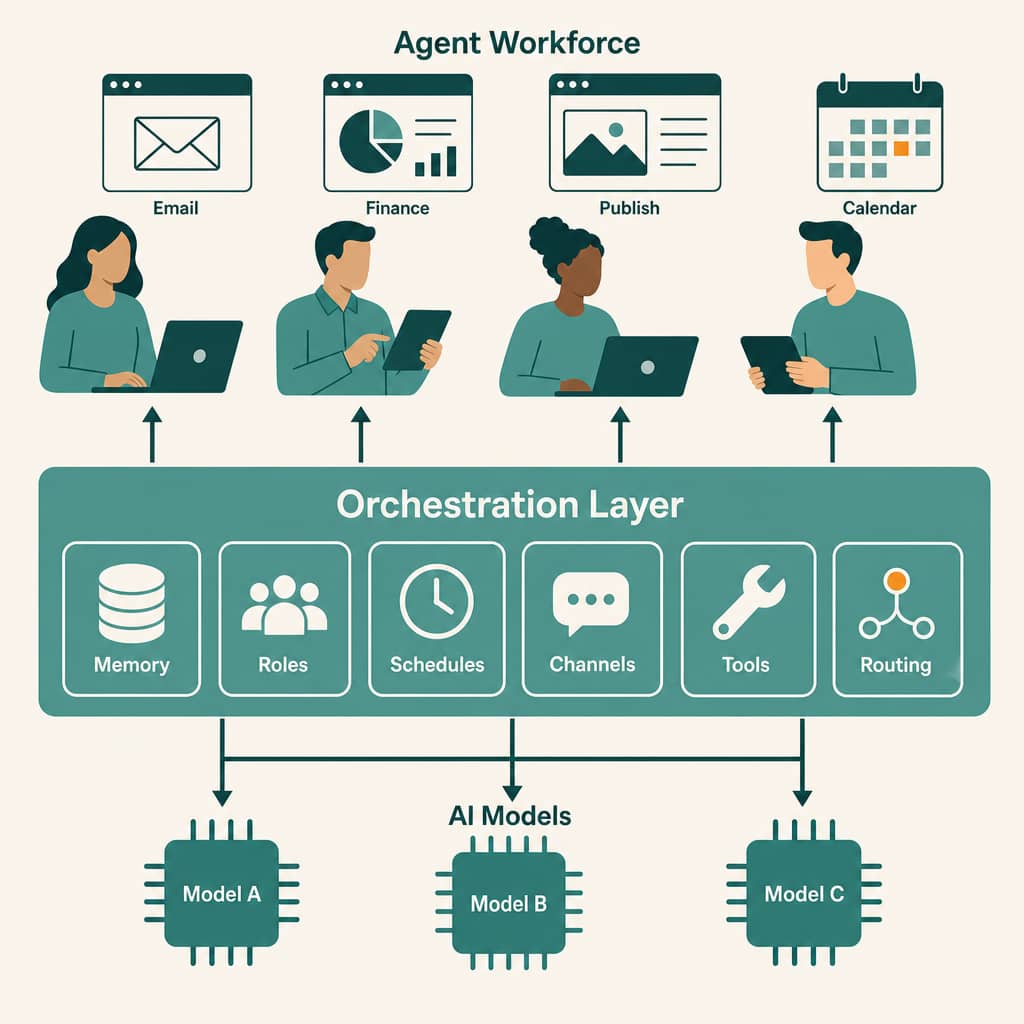
OpenClaw is a persistent, multi-agent runtime with memory, scheduling, and channels that let an agent do real work. It is open source under MIT, and that license is the engine behind everything else. The community keeps extending it with new roles, tools, and work patterns, without waiting on a vendor roadmap.
I knew immediately what I was looking at. Not a curiosity, not an anomaly. The missing piece in the agent landscape. A first spark for a layer category. Before that the community was speaking only about Agent orchestration FRAMEWORKS such as Langgraph or Crewai only for developer audience
Then Hermes shipped, and the spark became a pattern. Agent orchestration product is not a one-off. It is a category, and operators have already started running on it.
The public AI conversation still revolves around models. Bigger model. Higher benchmark. Press cycle. Repeat. Models are necessary, but they are not a business system. A model is an engine sitting on a bench. You don't drive an engine. You drive a vehicle built around it.
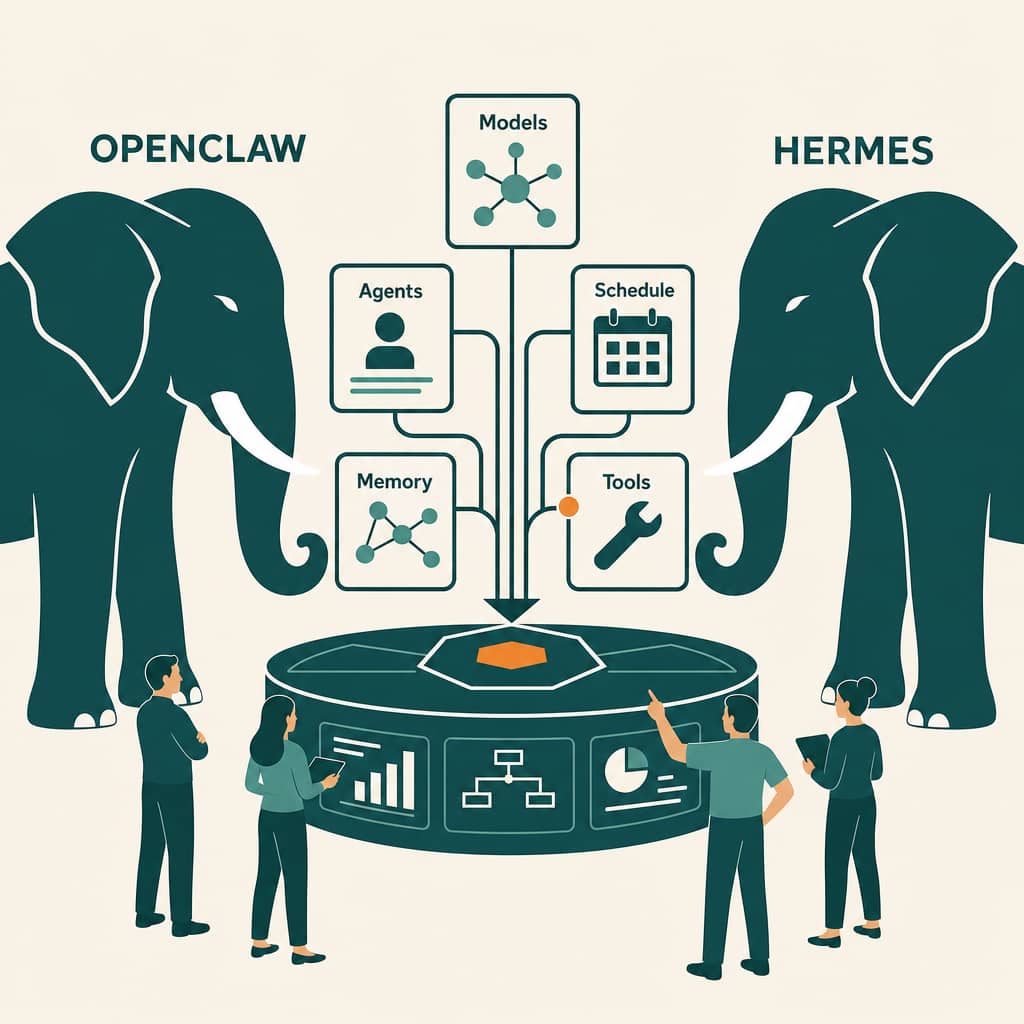
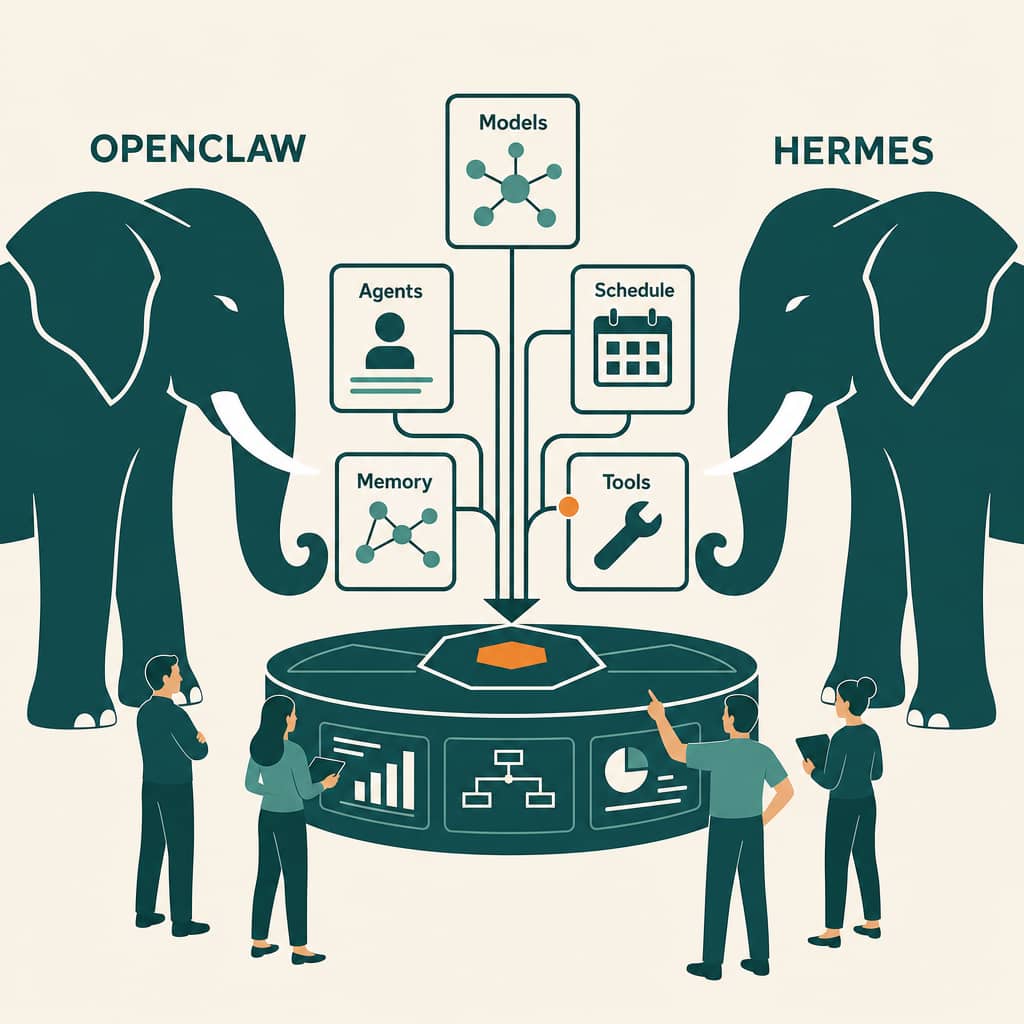
The orchestration layer is the vehicle. Until now we could code the orchestration with the frameworks so we had factory options but still not a car out of the box OpenClaw was the first elephant. Hermes is the second. There will be more.
What an Agent Orchestration Layer Actually Is
The category gets misread often, because the word "agent" now lives in too many product categories at once. Chat tabs that remember more. Coding tools that take actions. RPA platforms with an LLM bolted on. They all call themselves agents.
An orchestrator is something else.
Chat products are sessions. You type, they respond, the context dissolves when you close the tab. Coding assistants go further with execution and file control. They resemble orchestration but stay session-bound. Useful, fast, inherently reactive.
An orchestrator is a different category, it can take action:
- Persistent operation across time.
- Multi-agent coordination with explicit roles.
- Proactive scheduling that triggers work on cadence or events.
- Memory that survives beyond sessions.
- Channel routing across chat, email, and other surfaces.
- Tool integrations via standard interfaces like MCP.
Claude Code is a powerful coding session. Langgraph and Crewai are great frameworks, OpenClaw and Hermes are agent workforces that run whether you are at the keyboard or not and almost out of the box without developer skills needed
What OpenClaw Showed Me, and What I Still Needed
OpenClaw did something rare. It made a missing layer visible.
Before I ran it, the value gap between a capable model and a working business system without significant effort was a blur to me. If I needed orchestration I had to code it with LangGraph or equivalent, I also used AWS Bedrock to try improving the time to market . OpenClaw gave it both but not for all use cases. For that alone, it earned its place in my mental model. The perspective shift it delivered is worth more than the features.
But OpenClaw is not what I would put yet in front of an enterprise customer or a regulator.
I run my pet projects to production-grade standards. Cloud native. Multi-tenant. DR ready. Geo-localizable. Scaled by configuration, not by code changes. That is the bar I use on my own teams, on vendors, and on my own enthusiasm. An interesting product is not the same thing as an industry-ready stack.
OpenClaw, as it stands, is a builder platform. Fast to evolve, generous to operators, light on the controls a serious business needs before it lets agents touch real systems of record. Identity. Audit. Observability. Failure isolation none of that exists compared with Langgraph the reference in those domains. The unglamorous half of production. I run it to learn the category, not because I would build a P&L on it tomorrow.
The category is real. The first generation of orchestrator products proved the shape. The next generation has to prove the stack: reliable, industry-ready, open source.
Hermes is interesting to me on exactly those three axes. That is the real reason I held the post. I wanted to see whether the second elephant was built differently from the first.
What I Built on It
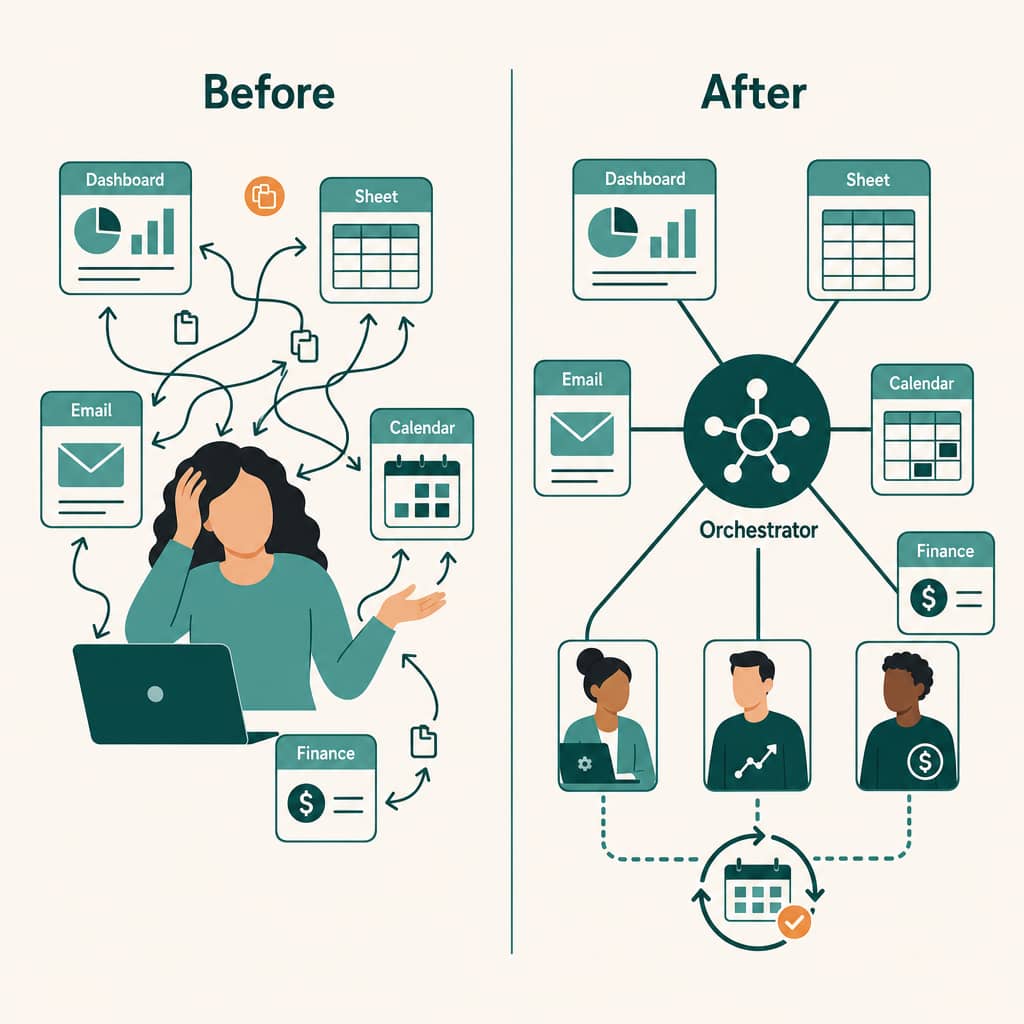
Before OpenClaw and AWS BedRock, my private stack was a pile of disconnected tools held together by copy-paste and habit. Finance in one app, calendar in another, publishing scattered across services. None of it knew anything about the others.
I wanted help doing work, not another dashboard. Orchestration gave me a way to compose roles that span tools and time. I set up a minimal environment and started small.
I now run specialized agents for the work I actually do:
- An executive assistant for email triage and calendar management.
- A finance role for portfolio tracking and analysis.
- A content manager for editorial strategy and multi-channel amplification.
- A career coach for professional development and positioning.
- A platform expert that maintains and extends the system.
Scheduling fires routine tasks without my intervention. Health checks keep things on track. Tool integrations connect the agents to the systems they must read and write.
Hermes: A New Entrant That Signals Acceleration
I spent the last 10 days running Hermes against OpenClaw, side by side. A quick first pass, not a real evaluation yet. Three things stood out enough to note now, and I will confirm them through day-to-day usage in the coming weeks.
- Stability and operability. Hermes holds together when you change things. Edit a config, swap a tool, restart, it keeps running. OpenClaw is still very immature in this dimension, where the same kind of change too often takes the system down. For an orchestrator that has to sit on a critical path, this is the difference between a builder toy and something an operator can actually run.
- Memory management. The way Hermes handles memory to limit bloating looks interesting on first pass. The premium Honcho integration is the other piece that caught my attention. Both need real usage to confirm, but the direction is the right one.
- Automatic skill creation and improvement. This is the most promising of the three, I believe it will become an industry standard soon. Hermes can create and maintain its own skills, not just load static plugin packages. If that holds up under day-to-day use, it is a meaningful step beyond what OpenClaw does.
The Shift-Left Connection
Business users are about to own technology again, and orchestration is the lever. For years, the answer to many workflows was a vendor or a ticket. The stack got so complex that operators lost their hands on the wheel.
Orchestrator products put agents in the hands of operators, not just developers as agent frameworks do AND make possible full data privacy and sovereignty. Shift-Left Everything: Why Agentic Working Is Taking Us Back to the 90s covers the broader thesis.
Does initial setup still require technical skill? A little. But the window is shrinking as packaging improves and patterns solidify.
The Paradigm Shift: You Own the Orchestration
Most executives still hear "AI agents" and think of a better ChatGPT tab or more CAPEX for a LangGraph implementation That is not the shift. The shift is architectural and it upends switching costs.
Consider the before and after:
- FROM: consuming external chat products. The provider owns state, memory, terms, and cadence with IP and sovereignty challenges or still relying on high capex and maintenance agent frameworks development
- TO: running an agent workforce on your stack that can call any model. You own orchestration, memory, and context. The domain experts are maintaining the agents efficiency themselves
For me it looks like the platform engineering principles applied to AI pipelines
What Comes Next
This post (Part 1) is the business implication: OpenClaw exposes why the orchestration layer matters and proposes a non developer based solution. Part 2, sovereignty, regulation and guardrails become board-level operating questions and is there a success path for enterprises
The Agentic-Native Company
If you strip away hype, the practical question is simple: what does agent-native execution look like at enterprise scale? It starts with treating self service agent orchestration as a first-class platform, owned by the operator. Product leaders define agent roles the way they define teams: scope, KPIs, escalation paths and EVOLVE them
You align incentives to outcomes, not prompts. Agents get SLAs, uptime targets, cost ceilings, and audit trails. Tool access is granted with least-privilege and revoked on a schedule, just like humans.
On my side, the pattern has held under real load. The orchestrator carries memory, context, workflows, and observability, while models come and go under it. That is how you de-risk adoption and compound capability over time.